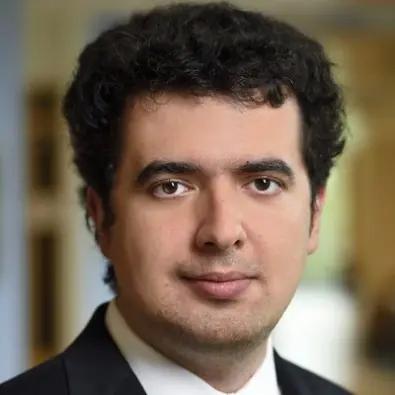
Semih Uslu
Institution
Johns Hopkins University
PhD Year
2016
FTG Membership
Member
Website
https://sites.google.com/site/semihusluweb/
Featured Work
Comparing Search and Intermediation Frictions Across Fixed-Income Markets
May 1, 2025
We develop a two-asset search-and-bargaining model of OTC trading to estimate frictions and welfare losses in the UK government and corporate bond markets. Using transaction-level data and a matched client sample, we find that both trading delays and intermediation frictions are more pronounced in corporate bonds. Welfare losses due to these frictions are 2.4% in government bonds and 5.0% in corporate bonds—driven primarily by trading...
Liquidity in the Cross Section of OTC Assets
May 1, 2024
We develop a dynamic model of a multi-asset over-the-counter (OTC) market that operates via search and bargaining and empirically test its implications regarding liquidity in the cross section of assets. The key novelty in our model is that investors can hold and manage portfolios of OTC-traded assets. We characterize the stationary equilibrium in closed form and derive natural proxies for asset-specific measures of market liquidity...
A Theory of Participation in OTC and Centralized Markets
Aug 26, 2023
Should regulators encourage the migration of trade from over-the-counter (OTC) to centralized markets? To address this question, we study a model in which banks make costly decisions to participate in an OTC market, a centralized market, or both markets at the same time. Banks differ in their ability to take large positions, what we call their trading capacity. In equilibrium, intermediate-capacity banks find it optimal...
Pricing and Liquidity in Decentralized Asset Markets
Dec 19, 2019
I develop a search-and-bargaining model of endogenous intermediation in over-the-counter markets. Unlike the existing work, my model allows for rich investor heterogeneity in three simultaneous dimensions: preferences, inventories, and meeting rates. By comparing trading-volume patterns that arise in my model and are observed in practice, I argue that the heterogeneity in meeting rates is the main driver of intermediation patterns. I find that investors with...